
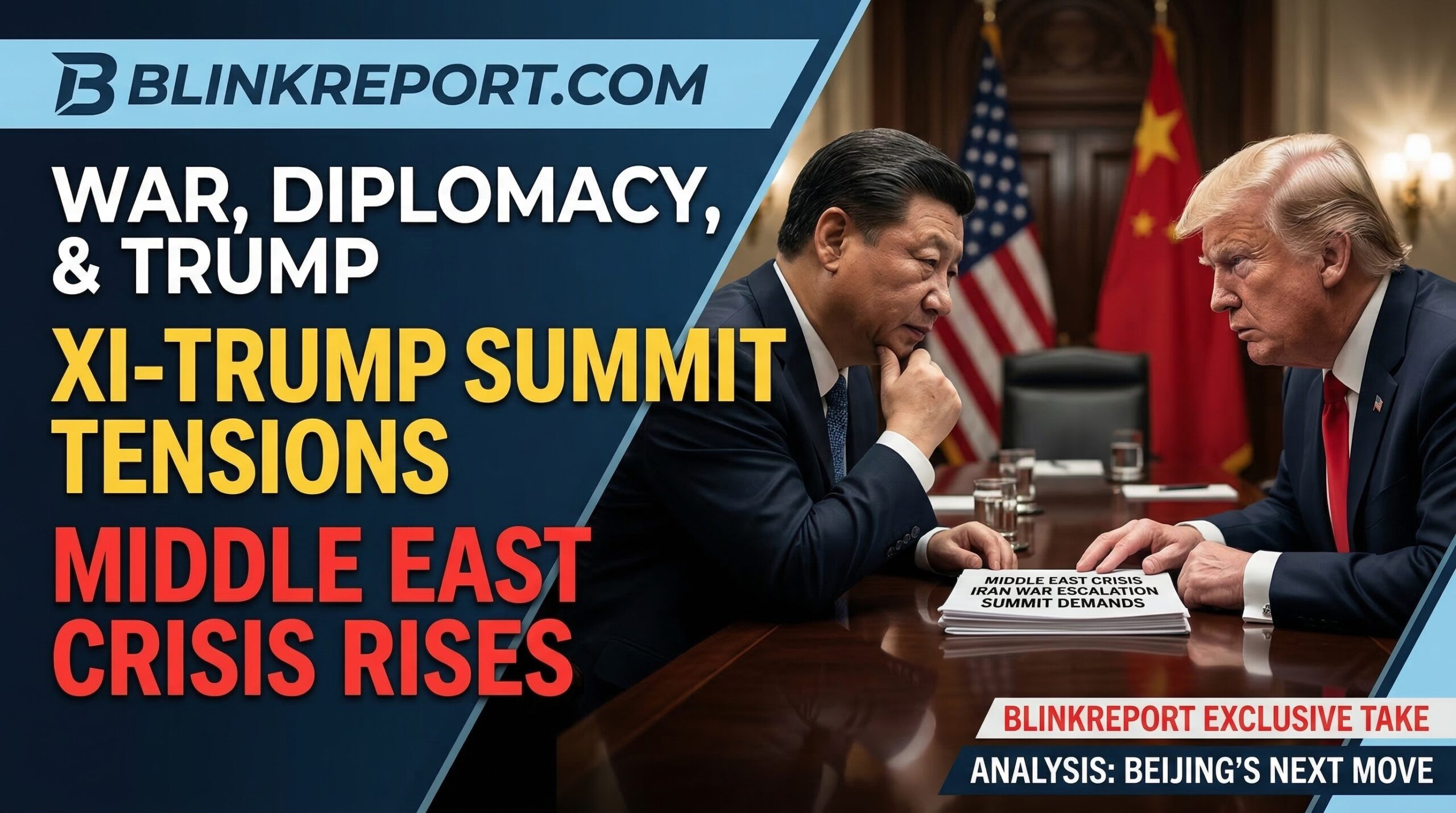
BEIJING — As the devastating war in Iran threatens to engulf the broader region and escalate the Middle East crisis, China is aggressively positioning itself as the globe’s primary anchor of stability. In a calculated diplomatic maneuver, Beijing is striking a conciliatory tone toward Washington just weeks before a high-stakes Xi-Trump summit.
Speaking on the sidelines of the National People’s Congress (NPC) annual assembly in Beijing, Chinese Foreign Minister Wang Yi delivered a stark warning about the expanding crisis. Condemning the escalation, Wang firmly asserted Beijing’s stance: “This was a war that should never have happened, and a war that benefited no one.”
Touting China as “the world’s most important force of peace, stability, and justice,” the top diplomat reiterated urgent demands for an immediate ceasefire. He warned against the catastrophic “spillover and spread of the flames of war,” urging all involved factions to abandon military force and return to the negotiating table for equal dialogue.
A Geopolitical Chess Match Amid the Middle East crisis
China’s heightened anxiety over the Iranian conflict arrives at a pivotal juncture. Later this month, President Xi will host President Trump in Beijing for crucial bilateral talks. While the summit’s agenda is already heavily burdened with complex global issues—ranging from persistent trade frictions to the delicate situation surrounding Taiwan—the rapidly deteriorating situation in the Middle East has injected a volatile new dynamic.
The stakes are immense. Following the US and Israeli strikes on Iran and the killing of Iranian leader Ayatollah Ali Khamenei, global oil prices have spiked, threatening to destabilize an already fragile global economy. While President Trump recently demanded “unconditional surrender” from Iran, Beijing—which has historically maintained robust economic ties with Tehran—is watching the fallout with profound alarm.
Capitalizing on Global Chaos
Beijing is seizing this turbulent moment to project the image of a reliable superpower, creating a sharp contrast with Washington. While the US navigates new Middle Eastern conflicts, the capture of Venezuelan President Nicolás Maduro, and an ongoing global trade war, China is offering itself as “an irreplaceable anchor amid global chaos,” according to Wang.
This strategy of projecting confidence appears to be paying off. China has largely weathered the recent tariff salvos from the Trump administration. Furthermore, a steady stream of traditionally close US allies—including French President Emmanuel Macron, British Prime Minister Keir Starmer, and German Chancellor Friedrich Merz—have visited Beijing in recent months. Acknowledging this shift, Wang noted that European leaders increasingly view China as a “global partner” rather than a competitor.
Defending the UN and the Moscow Alliance
Addressing global governance, Wang took an implicit swipe at President Trump’s proposed “Board of Peace,” vowing to defend traditional multilateralism. “Attempts to bypass the UN and start anew… or to cobble together small blocs and exclusive circles gain no support and are unsustainable,” he argued.
However, Beijing’s definition of stability has its limits. Wang notably omitted any mention of China’s aggressive export strategies, its weaponization of rare earths, or its escalating military pressure on Taiwan and in the South China Sea. Furthermore, he doubled down on China’s unwavering support for Russia amid the ongoing war in Ukraine, describing the Moscow-Beijing alliance as “unmoved by wind and rain, as stable as a mountain.”
The Economic Ripple Effect: Tech and Tariffs on the Table
Beyond the immediate crisis in the Middle East, the impending Xi-Trump summit is fundamentally anchored in the deep-rooted economic friction between the two superpowers. During his previous administration, President Trump initiated a historic trade war, levying heavy tariffs on hundreds of billions of dollars worth of Chinese goods. While the broader geopolitical landscape has shifted dramatically since then, the economic battlefield remains fraught with tension.
Beijing is acutely aware that a renewed push for stringent tariffs or further restrictions on Chinese technology exports—particularly in the vital semiconductor, artificial intelligence, and green energy sectors—could severely hamper its domestic economic recovery. China’s recent export-driven strategy, which has seen a massive influx of affordable electric vehicles (EVs) and solar panels flood global markets, is already facing intense scrutiny and retaliatory pushback from Western economies.
For President Xi, the upcoming summit in Beijing is a critical opportunity to negotiate breathing room for China’s beleaguered tech giants and its vast manufacturing sector. The diplomatic leverage China is currently trying to build as a “peacemaker” in the Middle East might just be the exact political currency needed to soften Washington’s aggressive economic containment policies.
The Economic Ripple Effect: Tech and Tariffs on the Table
Beyond the immediate crisis in the Middle East, the impending Xi-Trump summit is fundamentally anchored in the deep-rooted economic friction between the two superpowers. During his previous administration, President Trump initiated a historic trade war, levying heavy tariffs on hundreds of billions of dollars worth of Chinese goods. While the broader geopolitical landscape has shifted dramatically since then, the economic battlefield remains fraught with tension.
Beijing is acutely aware that a renewed push for stringent tariffs or further restrictions on Chinese technology exports—particularly in the vital semiconductor, artificial intelligence, and green energy sectors—could severely hamper its domestic economic recovery. China’s recent export-driven strategy, which has seen a massive influx of affordable electric vehicles (EVs) and solar panels flood global markets, is already facing intense scrutiny and retaliatory pushback from Western economies.
For President Xi, the upcoming summit in Beijing is a critical opportunity to negotiate breathing room for China’s beleaguered tech giants and its vast manufacturing sector. The diplomatic leverage China is currently trying to build as a “peacemaker” in the Middle East might just be the exact political currency needed to soften Washington’s aggressive economic containment policies.
The Taiwan Factor: The Unspoken Red Line
Looming large over every US-China interaction is the incredibly delicate issue of Taiwan. While Foreign Minister Wang Yi’s recent press conference heavily emphasized the urgency of the Middle East conflict, his relative silence on Taiwan speaks volumes. Beijing has consistently continued its military posturing and naval drills around the self-governed island, which remains the most dangerous flashpoint in US-China relations.
President Trump’s notoriously unpredictable foreign policy approach adds a thick layer of anxiety for both Beijing and Taipei. A key question heading into the summit is whether Taiwan will be leveraged as a bargaining chip in broader trade and global security negotiations. China’s calculated attempt to project itself as a responsible, stabilizing global force in the Middle East is simultaneously a strategic effort to consolidate its international power and deter any US interference in what Beijing staunchly considers its core internal affairs. By attempting to bind the US in Middle Eastern diplomacy, China hopes to secure a freer hand in the Indo-Pacific region.
BlinkReport’s Take: The Strategic Undercurrents
- The “Peacemaker” Leverage: By publicly adopting the mantle of the global peacemaker, Beijing is executing a calculated diplomatic maneuver. Ahead of the Xi-Trump summit, China aims to contrast its diplomatic approach with Washington’s military footprint, attempting to seize the moral high ground before grueling trade negotiations even begin.
- Economic Pragmatism over Politics: China’s call for a ceasefire is not purely altruistic. As the world’s largest importer of crude oil, a prolonged conflict in Iran and subsequent energy market disruptions pose a direct threat to China’s domestic economic engine.
- The European Pivot: The recent visits to Beijing by the leaders of France, the UK, and Germany signal a crucial shift. As US foreign policy becomes increasingly unpredictable, traditional Western allies are actively hedging their bets, a fracture in the Western bloc that Beijing is more than happy to exploit.